
You Are Stronger Than Circumstance: Time To Reclaim Your Power
Most individuals eventually confront a sobering realisation: they are not living a series of years, but rather the same year repeated on a loop. Despite possessing genuine talent, sharp intellect, and a hunger for change, many women find themselves stuck in undesirable circumstances. This state is not a reflection of your worthiness or potential; it is the byproduct of the familiar routine, or worse, the fear of the unknown.
We often remain far too long in that job, career or relationship, clinging to the familiar, a psychological chain that prioritises the safety of the status quo over the uncertainty of a future change or expansion. This stagnation makes life feel dull and uninspired, regardless of how secure our external circumstances may appear.
We become reliable for our employers and diligent in our social obligations, yet we remain strangely procrastinatory regarding the needs of our own souls. We often fail to recognise that we are in a position of shrinking, allowing our confidence and self-esteem to be eroded by the safety of where we are in life.
This listlessness is driven by hidden subconscious paradigms—the mental software that protects your current results as if they were a survival requirement. To break free, you must recognise that your current results are merely a snapshot, not a life sentence. By adopting specific, high-level psychological shifts, you can disrupt these closed systems of thinking and tip the scales of manifestation in your favour.
1. The 42% Rule: The Neuroscience of Command
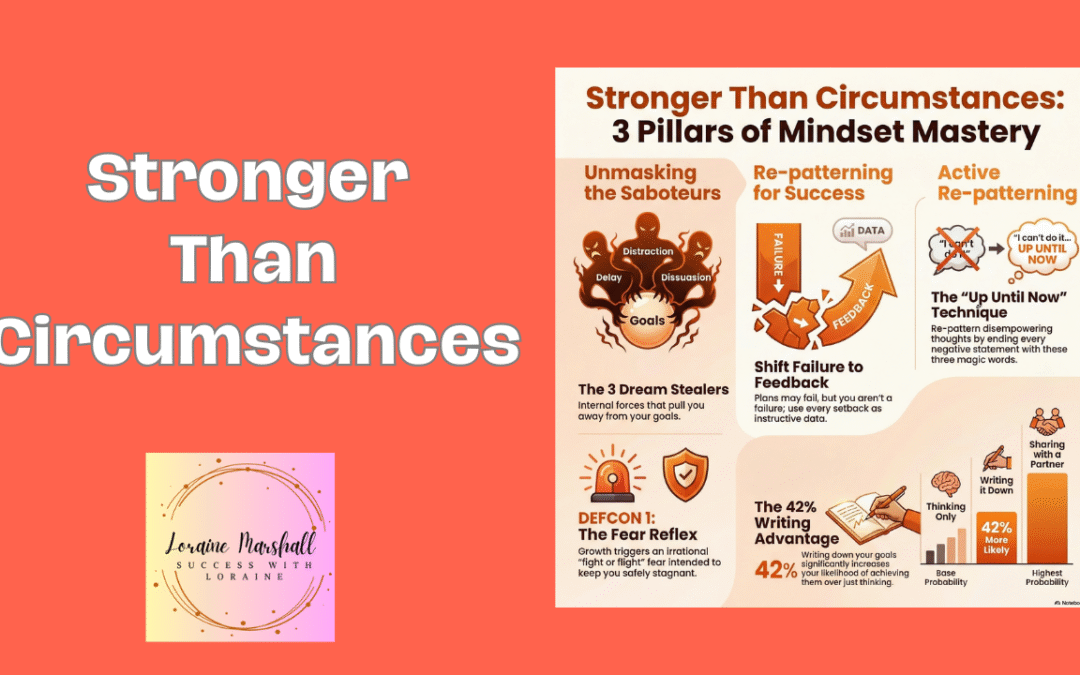
While many people “have dreams,” very few possess the discipline to externalise them. Research led by Dr Gail Matthews, involving a diverse cohort of entrepreneurs, healthcare professionals, and artists, revealed a startling statistical advantage: you are 42% more likely to achieve your goals simply by the physical act of writing them down.
This isn’t mere record-keeping; it is a sophisticated neurological event. The human brain’s two hemispheres are connected by the corpus callosum. When you put pen to paper, you create a functional bridge between the imaginative right brain and the literal, logical left brain. This physical movement sends a distinct electrical signal into the fluid surrounding the brain and throughout the spinal fluid, communicating to every cell in your nervous system that you “mean business.”
Mere thinking is a casual, internal process; writing is a declaration that alerts your consciousness to identify opportunities that were previously invisible to the uncommitted mind.
“Just the act of writing it down ignites in the subconscious mind another whole dimension of consciousness, of power, of ideas, and the ability to see opportunities that just can’t be seen if I’m just thinking about my goals.” — Mary Morrissey
The 7-Day Experiment: For one week, commit to writing down your primary goals and dreams every single morning. Notice how this ritual recalibrates your focus and heightens your awareness of the resources already present in your environment.
2. Mastery Through Feedback: Holding Two Black Belts
High-performance individuals do not fear failure; they respect it as a vital growth metric. In the pursuit of greatness, one must aim to hold two metaphorical “Black Belts”—one in Success and one in Failure. The degree in failure is equally instructive, as both sides of the growth spectrum are necessary for true mastery.
Take Thomas Edison, who famously reframed 10,000 unsuccessful attempts at the light bulb not as failures, but as the successful discovery of 10,000 ways that did not work. This is the hallmark of a “stronger than circumstances” mindset. Consider also the story of William Kamkwamba. Faced with a devastating famine and the inability to pay for school, he did not accept his circumstances as final. Using a bicycle and radio parts, he built a windmill that powered his family’s home, proving that resourcefulness is the ultimate antidote to lack.
The shift is in the identity: a plan may fail, but you are not a “failure.” When you treat every setback as high-level feedback, it ceases to be a barrier and becomes a propellant. Read this article: The Strength To Keep Going.
“Every adversity has within it the seed of an equal or greater benefit.” — Napoleon Hill
3. The Linguistic Expiration Date: Using the “3 Magic Words”
The ego maintains its grip through “closed systems” of language. When you say, “I can’t save money” or “I’m not a leader,” you are cementing your past as a permanent requirement for your future. These statements create a mental enclosure that forbids growth.
To hack this resistance, you must apply a linguistic expiration date to your old identity using the phrase “up until now.” This tool acknowledges the historical truth of your experience without allowing it to dictate your destiny. It signals to your subconscious that the “old way” has reached its limit and a new pattern is being established.
Re-patterning Your Internal Narrative:
- Closed System: “I struggle to find fulfilling work.” → Expanded System: “I have struggled to find fulfilling work… up until now.”
- Closed System: “I am always overwhelmed by my schedule.” → Expanded System: “I’ve been overwhelmed by my schedule… up until now.”
- Closed System: “I don’t have the confidence to speak up.” → Expanded System: “I haven’t had the confidence to speak up… up until now.”
4. Forgiveness as a Frequency Shift
Many people remain tethered to the past because they view forgiveness as a moral favour granted to a transgressor. In reality, forgiveness is a strategic “frequency shift” performed for your own liberation. To forgive literally means “to give for a perception”—you are trading a perception of bondage and pain for a perception of freedom.
Resentment operates on a low vibrational frequency that is fundamentally incompatible with the frequency of success. You cannot build a future you love while inhabiting the energy of a past you hate. As Mary Morrissey teaches, “Freedom and bondage don’t live on the same frequency.”
“Buddha said that to hold resentment is like picking up a hot coal; you mean to throw it at somebody else, but the person who gets most burned is the person who picks up the hot coal.”
Forgiveness does not require you to like or even interact with the person again. It simply requires you to drop the hot coal, freeing the energy previously wasted on pain to be reinvested in your vision.
5. Unmasking the Three “Dream Stealers”
As you move toward expansion, your subconscious ego will deploy insidious “stealth weapons” to pull you back into the familiar. These are not loud, external obstacles; they are quiet, internal subversions known as the 3 D’s:
Delay
This is the “not today” logic. It whispers that you will start when the kids are older, when the market is better, or next Monday. Delay uses the mask of “timing” to ensure that your dream remains safely in the future, never encroaching on the present.
Distraction
Distraction is the most ironic of the stealers because it often looks like productive work. You intend to write your business plan, but suddenly feel a “responsible” urge to do the laundry, clear your inbox, or organize your desk. Your paradigm won’t yell at you to stop; it will simply distract you with “safe” tasks that lack the vulnerability of true growth.
Dissuasion
If you bypass delay and distraction, your paradigm will attempt to talk you out of your worthiness. It will suggest that you didn’t really want the goal anyway, or that the stress of the “raise” isn’t worth the effort. It attempts to convince you that the contraction of your current life is more comfortable than the exertion required for expansion.
Conclusion: Feeding the Wolf of Expansion
Transformation is not a one-time event; it is a rigorous, daily practice of choosing which internal voice to empower. This choice is captured in the Cherokee story of the two wolves fighting within us. One wolf represents constriction: anger, regret, and ego. The other represents expansion: joy, faith, and possibility.
When the grandson asks which wolf wins the battle, the answer is unwavering: “The one you feed.”
Energy flows where your attention goes. If you focus on your limitations, you feed the wolf of constriction. If you focus on your “I Can”—that sense of possibility that is Life itself seeking expression through you—you feed the wolf of expansion. The “I Can” will always be more vital to your success than your IQ or your current circumstances.
In this moment, which wolf are you choosing to feed?

Recent Comments