
4 Mind-Bending Rules from a Top Therapist
Ever feel like you’re your own worst enemy? Do you find yourself self-sabotaging your diet, your career, or your relationships? Do you experience inexplicable anxiety or feel stuck in patterns you desperately want to change? These frustrations aren’t a sign of weakness; they’re often a sign of a simple misunderstanding about how your own mind operates. You need to rewire your brain.
Marisa Peer is a world-renowned therapist who has spent her career working with everyone from Olympic athletes and rock stars to CEOs and royalty, helping them achieve peak performance by understanding the brain. She’s discovered that our minds, in their effort to protect us, often work off outdated or misinterpreted information.
This article distils four of her most surprising and impactful rules for how the mind actually works. These aren’t just interesting theories; they are practical, actionable principles you can use today to stop fighting your brain and start directing it toward the life you want.
1. Your Brain Takes Your Exaggerations Literally
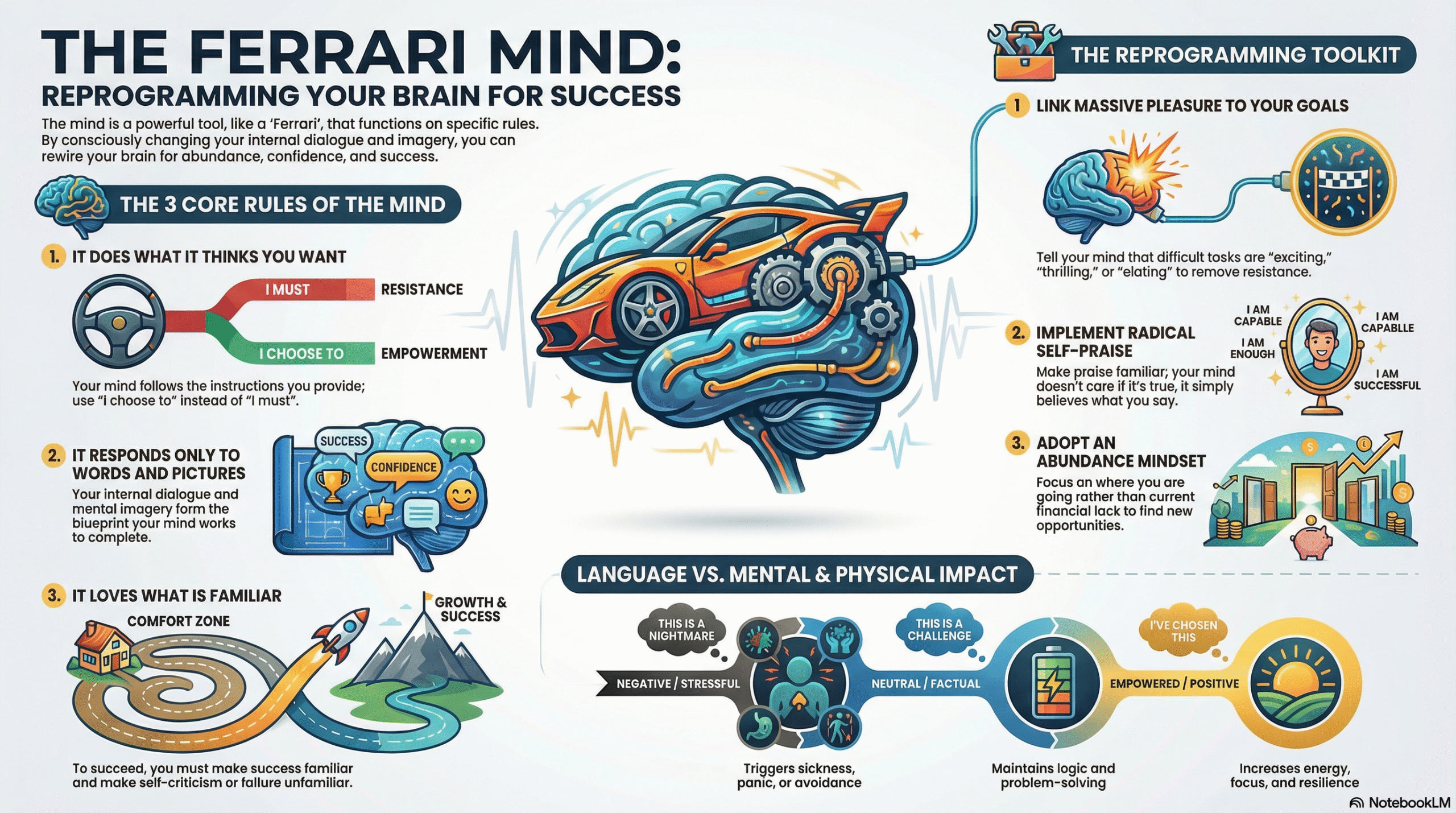
Your brain has one primary job: to do what it thinks you want it to do to keep you alive on the planet. Its main survival strategy is to move you away from anything it perceives as pain. Here’s the mind-bending part: your brain does not differentiate between a genuine, life-threatening danger and the casual, exaggerated language you use every day.
Think about the phrases you toss around without a second thought. Saying things like “This traffic is killing me,” “I’m dying in this job,” or “I’d die if I had to go on stage” aren’t just expressions to your subconscious. Your brain interprets them as literal commands to be avoided at all costs. It hears “killing,” “dying,” and “die,” and its only goal becomes to “save” you from the situation you just described as a source of immense pain.
How does it save you? By manifesting physical symptoms. To prevent you from chairing that meeting you said you’d “do anything” to avoid, it might give you a sudden migraine, an upset stomach, or a full-blown panic attack. It’s not trying to sabotage you; it’s following your instructions to the letter.
“When you say, ‘Oh my god, I’d give anything not to have to chair that meeting,’ my mind goes, ‘How about a nice dose of diarrhoea? I can bring that up for you.’ You don’t want to chair that meeting. You said, ‘I’d do anything not to go.’ ‘I’d rather kill myself than give that presentation to my boss,’ and I go, ‘Don’t kill yourself, I’ll just give you a really upset stomach. Now you can’t even leave the bathroom.'”
This is why it’s so critical to become highly conscious of the words we use. Our daily self-talk is a constant stream of instructions to our brain. To regain control, we must be specific, deliberate, and stop describing minor inconveniences as life-or-death threats.
2. Lying to Yourself Is a Recommended Superpower
The brain responds to only two things. The pictures you make in your head and the words you say to yourself. A stunning consequence of this is that your brain doesn’t care if what you tell it is true or false. If your brain is already acting on your accidental negative exaggerations, imagine the power you can unlock by feeding it deliberate, positive lies.
Marisa Peer shares a story of being on a terrifying ride at Disneyland with her daughter. Instead of screaming in fear, which would only reinforce the danger to her brain, she started shouting, “Yay, this is fantastic! I love this, it’s amazing!” She wasn’t feeling it at all, but her brain became confused. It heard words of excitement and saw images of fun, and her body’s response began to shift from terror to thrill.
This might sound like you’re just tricking yourself, and Peer’s response to that is a resounding yes.
“And she said, ‘So should I lie to myself?’ I’m like, ‘Absolutely. All the time. A hundred percent you should lie to yourself.'”
Consider the practical example of dieting. The ineffective approach is telling yourself, “I love chocolate, but I can’t have it.” Your brain hears “love” and “deprivation,” creating immense internal resistance. The effective approach is to reframe it with a better lie: “I like being a size 10 way more than I like that cake. I’m choosing to look good in my clothes.” This simple shift from “can’t” to “choose” reframes the entire experience from one of painful deprivation to one of empowered choice, eliminating your brain’s resistance.
3. To Succeed, You Must Make Praise Feel Normal
One of the most powerful and counter-intuitive rules of the mind is that it loves what is familiar and resists what is unfamiliar. This is the primary reason we often stay stuck in negative patterns. It’s not that we enjoy self-criticism, unhealthy relationships, or procrastination. It’s that they are deeply familiar to our brains, which resist anything unfamiliar because they perceive it as a potential source of pain or danger.
Marisa gives the powerful example of a client who met a kind, wonderful man but wanted to end the relationship because he was “too good for me.” The real issue wasn’t her worthiness; it was that being treated poorly was familiar, while being treated with respect was unfamiliar and therefore deeply uncomfortable for her subconscious. This means your subconscious will actively reject genuine kindness if its baseline is criticism, because kindness feels like a threat to its world. Your brain will actively sabotage positive experiences to return to a state of familiar negativity because it equates “familiar” with “safe.”
The key takeaway is simple but profound. If you want success, you must make positive things like self-praise, achievement, and being treated well familiar. Simultaneously, you must make negative things like self-criticism and failure unfamiliar.
The actionable advice is direct: praise yourself constantly. Say, “I’m amazing, I’m kind, I’m significant,” until it feels normal. When you make a mistake, reframe the harsh self-criticism. Instead of calling yourself a “stupid idiot,” switch to a softer phrase like “you silly billy.” It may sound trivial, but it breaks the cycle of harsh, familiar criticism that holds you back.
“Depression is usually caused by harsh, hurtful, critical words that you say to yourself over and over again. Make that unfamiliar.”
4. To Become Wealthy, Act Abundant—Especially When You’re Broke
The final rule is a game-changer for your relationship with money. The principle is that even when you have no money, you must adopt an abundant mindset. Why? Because focusing on lack—using phrases like “I can’t afford it” or “I’m broke”—causes your mind to contract. It shuts down and stops looking for opportunities.
Peer shares her own experience of being a single parent and “in a lot of debt.” Critically, she notes, “I never said we’re poor.” This distinction between a temporary financial state (broke) and a permanent identity (poor) is vital. If her daughter wanted a toy, the answer wasn’t “we can’t afford it,” but “you can have that toy later.” To reinforce their own feeling of wealth, she would take her daughter to feed homeless people, which made them feel abundant by comparison.
Jack Canfield, author of Chicken Soup for the Soul, provides a perfect example of this principle in action. Before he was a household name, he put a vision board on his wall. He took a copy of the New York Times bestseller list, used white-out to erase the #1 title, and wrote in Chicken Soup for the Soul. He looked at that vision every single day, programming his mind for the abundance he wanted to create.
“You have to have an abundant mindset even when you have no money. As odd as that sounds, you need to say things like, ‘I’m wealthy, I have everything, I have so much.'”
When you shift your internal language from “I’ll never have that” to “I’m having that car” or “More is coming to me,” you send a powerful signal to your mind. Instead of shutting down, it begins to actively scan your environment for ways to make your new statements a reality. You move from a state of poverty to a state of abundance first in your mind—the necessary first step to creating it in your reality.
Conclusion: You Are the Driver
The overarching theme of these rules is that you are not a passenger in your own life; you are the driver. Your mind is an incredibly powerful machine. As Peer says, “The subconscious is the Ferrari, the conscious is the driver.” For too long, you may have let that Ferrari drive on autopilot, guided by old habits and misinterpreted instructions. By understanding these four rules, you can take the wheel and consciously direct that power where you want it to go.
If these rules resonated with you, the Mindset Money Success podcast explores some of these ideas in even greater depth. Sharing this article with someone who needs to hear it is the best way to support our mission. For those who wish to contribute further, you can find our “buy me a coffee” link at the bottom of the page.

Recent Comments